Your Body in Action
In this module, you will read and see more about:
I. Staying Active with OI
Staying active is great for your body and your mind, and that’s true if you have OI. Research shows that the stronger your muscles are, the stronger your bones become. That’s why strength training can help build up your bones too.
People with OI may have joints more flexible than usual, which can make them feel less stable. Thus, strength training can help with that and make your joints more steady and your body feel more in control.
Whether you’re working out at home or in a gym, strength training can help you. A strength training plan might use your own body weight, free weights, resistance bands, or gym equipment.
⚠️ It’s important to talk to your physiotherapist or doctor to find out if you have any activity restrictions and about the best types of exercise for you.
At times when your pain is severe, or have a fracture, you may need to restrict or modify some activities temporarily.
II. Types of Physical Activity
It’s important to remember that your joints may move differently from your peers because your bones are formed in a different way – sometimes they may be bowed or shaped differently – and this can affect your range of motion.
⚠️ Because of these differences, stretching isn’t always recommended. Therefore, before starting any stretching or exercise program, it’s strongly recommended that you first consult a physical therapist (PT) or occupational therapist (OT). They can assess your joints and movements and create a personalized plan that’s safest and most appropriate for you.
- Stretching and Range of Motion Exercises
Range of motion (ROM) refers to how much a joint can move in different directions. A contracture is severe joint stiffness. ROM exercises help prevent contractures and improve joint movement. These gentle stretching exercises can be done safely on your own. Since most daily activities don’t move your joints through their full range, regular ROM exercises are important.
If a joint has restricted ROM, regular stretching can help maintain mobility, especially if the limitation is due to lack of movement. However, these exercises are most effective when done consistently, which many people find challenging. Focus on the exercises that matter most to you, working on your stiffest joints as regularly as possible. You can also fit them into your routine by taking short breaks from homework or computer time. A physiotherapist can guide you in choosing the right exercises.
Stretching is essential for reducing stiffness and keeping joints and muscles flexible, making daily activities easier. It gradually expands your ROM, improves flexibility, and reduces pain and stiffness, helping you move more comfortably. To decrease stiffness, stretches need to be done regularly.
Stretching Tips:
- Warm up first: Move around for 5–10 minutes or stretch after a hot shower or bath.
- Stretch slowly: Hold each stretch for at least 20 seconds. No bouncing!
- Stay consistent: Stretch at least 3–5 times per week for the best results.
- Get guidance: A physiotherapist can recommend specific stretches for you.
Note: ROM exercises focus on joint movement (e.g., bending the knee), while stretching targets muscle length (e.g., stretching the quadriceps).
- Strengthening Exercises
These exercises can help to maintain or improve muscle strength. Strong muscles help make strong bones and that is especially important for people with OI. There are different types of strengthening exercises. Your physiotherapist or doctor can help you determine what exercise is right for you.
Isometric
In these exercises, you tighten your muscles without moving your joints. They are usually very safe exercises, because your joints do not move during these exercises, making them more comfortable when your joints are painful.
Isotonic
In these exercises, you use your muscles while moving your joint(s) through some range of motion. Isotonic exercises can be done with or without resistance added. Resistance can be added with the use of your own body weight. You can also add external weights such as ankle or wrist weights or elastic exercise bands. A general rule of thumb is that if you can complete two sets of 10 repetitions of an exercise easily, you can add some resistance. Start with a low weight (e.g. 1 lb to 2bs) or low resistance band. Build up slowly as you are able.
- It is important to be in the correct position when doing these exercises. A little bit of muscle soreness the next day is OK. However, these exercises should NOT make your joints more sore or swollen.
- It is important to safely challenge your body by adding weights gradually and listening to your body, increasing repetitions, or doing extra series.
- But remember to take rest days – they’re important to help your body recover and come back stronger for your next session!
Talk to your physiotherapist or another exercise expert before starting a strengthening regime. Generally speaking, people with OI will use the principles of low weight placed close to the joint with higher repetitions. A good starting point may be 10 repetitions of an exercise, a brief rest (30 to 60 seconds), and then a repeat set of 10. Do this three to five times per week. This is the type of routine that we know will help improve your muscle strength and endurance. Exercising, even with very little resistance, will provide benefits!
- Cardiovascular Fitness
Cardiovascular fitness is the ability of your lungs to provide oxygen to your blood and heart, and to transport that oxygen to the cells in your body.
Having a good cardiovascular fitness will allow you to perform physical activity for long periods of time. It can help you maintain a healthy weight, help control your pain, and improve your sleep and mood.
In order to improve cardiovascular fitness, an exercise must be intense enough to raise your heart rate and maintain it for a period of time. Any continuous activity will help. Swimming, water aerobics, brisk walking, dancing, and cycling may be good choices.
Before starting any aerobic exercise (such as walking, swimming, or cycling), it’s important to have a medical check-up to assess your heart function (baseline cardiac evaluation, like an echocardiogram), and identify any risks. This helps to check heart health and ensure physical activity is safe.
If you are interested in learning more about your heart rate, target heart rate, and how to monitor the intensity of your exercise, check out this link:
http://www.actnowbc.ca/EN/everyone/physical_activity_guidelines:_f.i.t.t./
Consult a physician before starting any exercise program and a physiotherapist for adapted activities. Discussing with a physical education teacher about adapting sports for people with OI can also help!
- Creating your own goals: Learn examples of SMART goals and tips on 🔗 staying active!
III. Sports and OI
- Swimming [LINK]
- Synchronized swimming
- Kayaking
- Riding a bike, tricycle, or a stationary bike
- Badminton [LINK], ping pong, tennis
- Archery
- Golf
- Yoga [LINK]
- Dancing [LINK]
- Walking, power walking, hiking
- Going for a ride or racing in a manual wheelchair
- Wheelchair sports (like tennis, baseball, basketball, track and field, etc.)
Making sports fun, accessible, and safe
- Team sports
- Play in smaller teams to reduce the chances of falling or bumping into someone.
- Let your teammates know about your OI, so they can be more supportive.
- If you’re okay with it, wear a different colour shirt to help others spot you more easily and avoid accidents.
- Pick the safest positions:
- Baseball: Try pitching or playing in the outfield.
- Floor hockey: goalkeeper is a good option. Just make sure to wear proper gear and use a soft ball.
- Wear shoes with good ankle support to help prevent injuries, since OI can make joints very flexible.
- Ball sports
- Use a softer ball to reduce the risk of injury. For example, a foam soccer ball or a beach ball for volleyball.
- Racquet sports
- Hold your racquet with two hands.
- Use softer balls.
- Cycling/tricycle
- Choose a tricycle with a wide base for more stability.

- Keep the seat low to lower your center of gravity (less chance of tipping over).
- An adapted bicycle or tricycle may be necessary for some youths.
- Wide stabilizing wheels are available on the market. They can be a good option to increase cycling safety if you can’t use a regular bike, but you don’t need further modifications.
- Use stationary bikes at home, at school or at the gym. They can be a good alternative to riding outdoors. Exercise pedalboards are also a less expensive and less cumbersome option. They can be used with either feet or hands.
- Wheelchair sports
Wheelchair sports can be a wonderful way to stay active. Activities such as wheelchair sports can help build upper body strength, coordination, and confidence, while adapting to each person’s unique abilities. There are many options to explore, and it’s strongly
recommended that you consult a physical therapist or occupational therapist first to find a sport that best suits your needs.
You can even track your physical activity using a smartwatch. Many smartwatches offer a wheelchair-specific workout mode, allowing you to record your movements, monitor your progress, and stay active in a way that’s adapted to you.
Check out our OI Athletes section and meet Antya Posadas [link to OI Athletes section], a young wheelchair dancer athlete who combines movement, rhythm, and artistry, allowing her to enjoy physical activity in a beautiful and enjoyable way.
Ways to make sports more accessible
- Adapt the Equipment or the Setting
- Use a lighter, smaller racquet for tennis or badminton.
- Try a lighter crossbow or slingshot for archery.
- Lower the net for volleyball or badminton.
- Use a double kayak so paddling can be shared.
- Change the Rules
- Make the playing area smaller (for badminton and tennis, for example).
- In tennis, let the ball bounce more than once before returning it.
- Set clear zones for each player to avoid bumps or crashes (volleyball, badminton).
- For wheelchair sports (like hockey), a friend can help by pushing your chair if needed.
- Using Technology
- You can stay moving, even at home, with active video games like Ring Fit Adventure (Nintendo Switch) and Just Dance (Wii Fit).
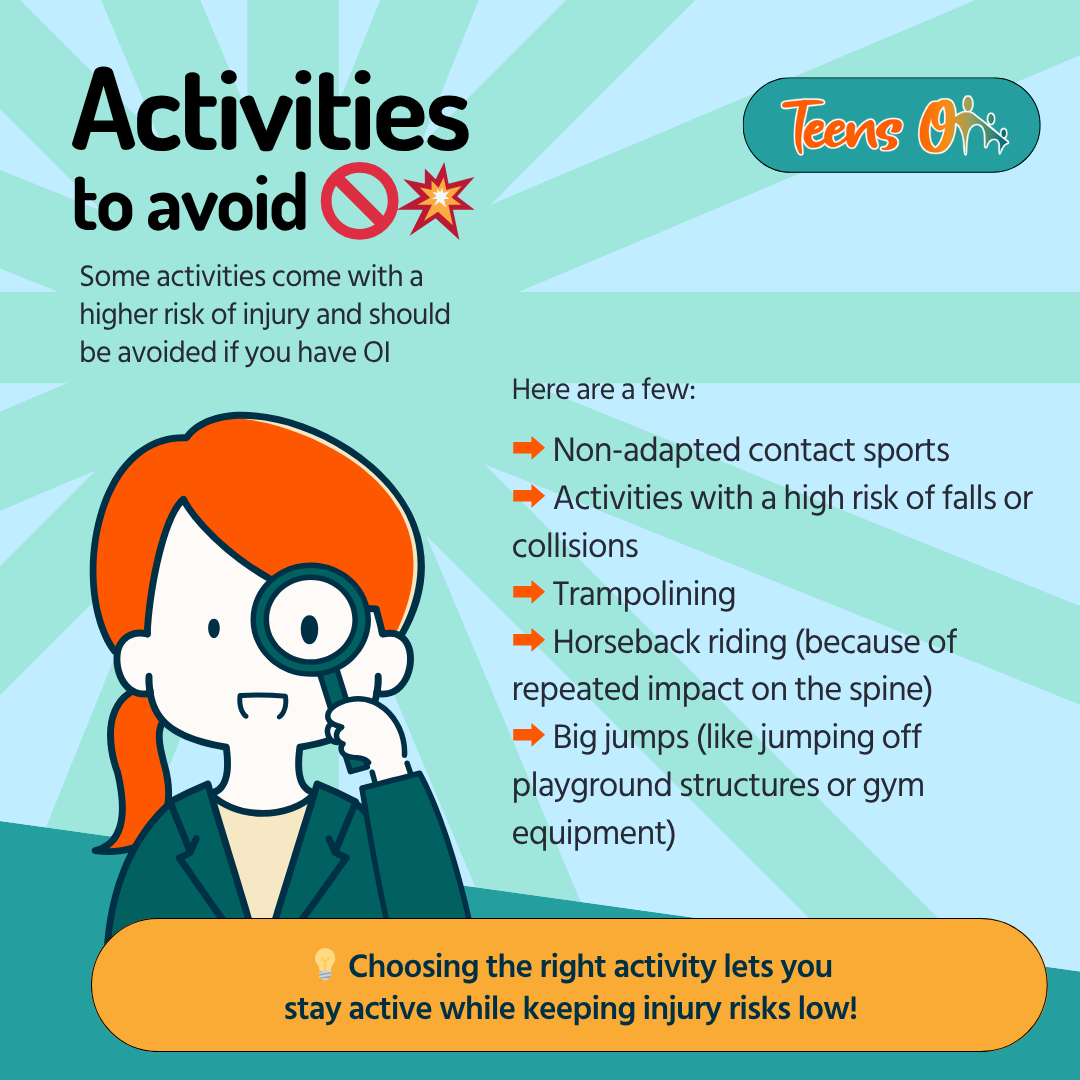
- Activities to Avoid
There are some common sense restrictions on the types of sports and leisure activities you can do. For example, contact sports, and trampolines are highly discouraged. Talk to your physiotherapist or doctor to find out which sports and leisure activities are appropriate for you.
IV. Exercise to Relieve Other Symptoms
Engaging in regular exercise can benefit your overall health and well-being! Here are just a few other benefits that will inspire you to move:
- Can help you sleep better
- Can help strengthen your bones
- Can help move bowels
- Can help relieve constipation.
About relieving constipation
Adding exercise and physical activity can help prevent and relieve constipation. Exercise helps move digested food through the intestines. Teens who use their wheelchairs to move around in their homes are at greatest risk of constipation. People should consult with their primary care doctor and physiotherapist about beneficial exercises that suit their particular needs and abilities. For example, infants benefit from water play that encourages them to kick. Children and adults can benefit from multiple physical activities such as swimming, walking, biking, kayaking, etc.
(Reference: IOF 🔗 https://oif.org/wp-content/uploads/2019/08/Constipation-1.pdf )
You can learn more about Constipation and OI at the Module What is OI [add link].
Meanwhile, you can 🔗 watch this video with some tips:
It can be tough to determine what is normal or abnormal regarding stool consistency, which is why healthcare professionals use the Bristol Stool Chart. This tool helps judge how long the stool has spent in the bowel.
Type 1 stool takes the longest journey through the bowel, while type 7 makes a quick exit!